
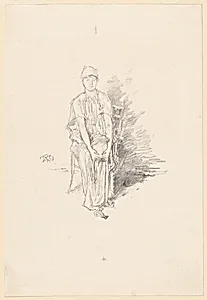
Figure Study in Colors
Medium
Transfer lithograph in black on ivory wove paper
Dimensions
Image: 16.9 × 14 cm (6 11/16 × 5 9/16 in.); With registration marks: 25.9 × 14 cm (10 1/4 × 5 9/16 in.); Sheet: 31.9 × 21.9 cm (12 9/16 × 8 5/8 in.)
Classification
transfer lithograph
Department
Prints and Drawings
Museum
Art Institute of Chicago
Accession Number
139382
Rights
Public Domain
Art Historical Context
James McNeill Whistler’s *Figure Study in Colors* (1890) is a delicate transfer lithograph black ink on ivory wove paper, just 16.9 × 14 cm at its core image. Housed in the Art Institute of Chicago Prints and Drawings department, intimate work exemplifies Whistler’s late-career fascination with printmaking, a medium he embraced in the 1880s and 1890s to fluid lines and tonal subtlety. Though rendered in monochrome, the title hints at Whistler’s broader experiments with color harmonies, evoking the Aesthetic movement’s mantra of “art for art’s sake,” where beauty trumped narrative. Transfer lithography allowed Whistler to draw spontaneously on paper before transferring the image to a lithographic stone, preserving his loose, expressive strokes. This technique, innovative for its time, enabled multiple impressions while capturing the artist’s signature economy of line—seen here in the poised figure study that prioritizes form and suggestion over detail. Whistler, an American expatriate in London, produced over 100 lithographs, often depicting everyday urban life with poetic restraint, influencing modern printmakers. As a window into Whistler’s technical mastery and philosophical ideals, this piece invites visitors to appreciate the quiet elegance of process and perception in Victorian-era art. Its small scale belies its significance in bridging painting and print traditions.
About the Artist
James McNeill Whistler · 1834–1903
James Abbott McNeill Whistler (1834-1903) was an American-born painter and printmaker who became a leading figure in the Aesthetic Movement and pioneer of Tonalism and Japonisme. He revolutionized art by championing "art for art's sake" and treating paintings as visual equivalents of musical compositions, titling works as "arrangements," "harmonies," and "nocturnes" to emphasize formal qualities o...