
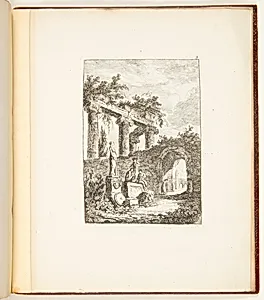
Figures in a Landscape with Columns and a Statue
Medium
Classification
Department
Smithsonian Collection
Museum
Smithsonian American Art Museum
Credit
Purchased for the Museum by the Advisory Council
Accession Number
1921-6-497-3
Rights
Public Domain
About this artwork
Research in Progress
Art Historical Context
Hubert Robert, a masterful French artist (1733–1808) often called "Robert des Ruines," created *Figures in a Landscape with and a Statue* around 1763–64. This evocative print captures his signature style: vast, atmospheric landscapes dotted with classical ruins, evoking the grandeur of ancient Rome. Produced during or just after his formative years in Italy (1755–1764), where he sketched real antiquities like the Colosseum and temples, the work features elegant columns, a solitary statue, and wandering figures, blending human scale with monumental decay. As a print in the Smithsonian American Art Museum's collection—purchased by the Advisory Council—this piece exemplifies Robert's neoclassical romanticism. Prints like this were revolutionary, allowing his imaginative visions of picturesque ruins to reach a broader audience beyond oil paintings. They highlight the 18th-century fascination with the Grand Tour, where aristocrats sought inspiration from antiquity amid the Enlightenment's embrace of history and nature. Robert's technique in prints emphasized light filtering through arches and foliage, creating a sense of timeless melancholy. Though research on this specific work continues, it embodies his enduring legacy: transforming ruins into poetic meditations on time's passage, inviting viewers to ponder the fragile beauty of the past.