
Figures inside a prison (recto), a monstrous animal (verso)
ca. 1820–50 (or later)
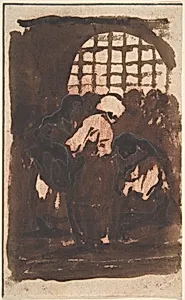
Medium
Brush with brown, black wash over red chalk on wove paper
Dimensions
5-15/16 x 3-5/8 in. (15.1 x 9.2 cm)
Classification
Drawings
Department
Drawings and Prints
Museum
Metropolitan Museum of Art, New York, NY
Credit
Bequest of Harry G. Sperling, 1971
Accession Number
1975.131.219
Rights
Public Domain
Tags
Art Historical Context
Francisco de Goya y Luc, the visionary Spanish artist of the late 18th and early 19th centuries, created this haunting double-sided drawing around 1820–50, during his later years marked by political exile and profound introspection. Titled *Figures inside a prison (o), a monstrous animal (vers)*, it exemplifies Goya's shift toward raw, unflinching explorations of human suffering and the grotesque, themes central to his "Black Paintings" and print series like *Los Caprichos* and *Disasters of War*. At just 5-15/16 x 3-5/8 inches, this intimate work on wove paper was likely a personal sketch, reflecting his Romantic preoccupation with madness, oppression, and the primal. On the recto, shadowy figures huddle in a prison, evoked through Goya's masterful use of brown and black wash over red chalk—a technique that builds dramatic contrasts and atmospheric depth with fluid, expressive strokes. The verso reveals a snarling monstrous animal, amplifying the sense of lurking menace. This dual imagery captures Goya's critique of tyranny and inhumanity, possibly alluding to Spain's turbulent post-Napoleonic era, where prisons symbolized both literal incarceration and societal horrors. Housed in the Metropolitan Museum of Art's Drawings and Prints department (Bequest of Harry G. Sperling, 1971), this piece invites visitors to ponder Goya's enduring legacy: a bridge between Enlightenment rationality and modern psychological depth, reminding us of art's power to confront darkness.
About the Artist
Goya (Francisco de Goya y Lucientes) · 1746–1828
Francisco José de Goya y Lucientes (1746-1828) was a Spanish painter and printmaker considered the last of the Old Masters and the first of the moderns. Rising from modest provincial origins to become First Court Painter to Charles IV, Goya's career spanned the Enlightenment's optimism and the brutal Napoleonic invasion that shattered it. A mysterious illness in 1793 left him permanently deaf and ...