
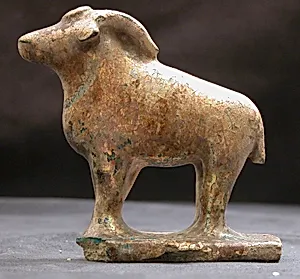
Figurine of a Bovine
Unknown Artist
12th century
Medium
Stonepaste; transparent turquoise glaze (iridized)
Dimensions
Ht. 3 1/8 in. (7.9 cm) W. 3 5/16 in. (8.4 cm) D. 1 5/8 in. (4.1 cm) Wt. 3.4 oz. (96.4 g)
Classification
Ceramics
Department
Islamic Art
Museum
Metropolitan Museum of Art, New York, NY
Credit
Theodore M. Davis Collection, Bequest of Theodore M. Davis, 1915
Accession Number
30.95.153
Rights
Public Domain
Tags
Art Historical Context
This delicate *Figurine of aine*, crafted in the 12th, exemplifies the ingenuity of Islamic ceramic artists from the medieval East. Standing just over three inches tall, this smallpaste sculpture—likely from regions like Iran or Syria—captures a sturdy, stylized cow with a serene expression, its form enlivened by a transparent turquoise glaze that shimmers with anidescent, jewel-like quality. Stonepaste, a composite of quartz, clay, and glass frit, was a revolutionary medium developed by Islamic potters around the 10th century to mimic the translucency of coveted Chinese porcelain, allowing for vibrant glazes and intricate designs. The figurine's turquoise hue, a hallmark of Seljuq-era ceramics (circa 11th–12th centuries), evokes the natural beauty of lapis lazuli and turquoise stones prized in Islamic culture, often symbolizing paradise or divine protection. Bovines, as vital symbols of fertility, sustenance, and pastoral life, frequently appeared in decorative arts, blending everyday utility with spiritual resonance. This piece's modest size suggests it may have adorned a domestic space or served as a talismanic object. Now housed in the Metropolitan Museum of Art's Islamic Art Department, thanks to the Theodore M. Davis Collection (1915), it invites us to marvel at the technical mastery and cultural vibrancy of a golden age of craftsmanship, where art bridged the functional and the fantastical.