
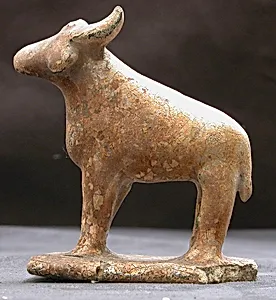
Figurine of a Bovine
Unknown Artist
12th century
Medium
Stonepaste; transparent turquoise glaze (iridized)
Dimensions
H. 3 1/2 in. (8.9 cm)
Classification
Ceramics
Department
Islamic Art
Museum
Metropolitan Museum of Art, New York, NY
Credit
Theodore M. Davis Collection, Bequest of Theodore M. Davis, 1915
Accession Number
30.95.154
Rights
Public Domain
Tags
Art Historical Context
This charming figurine of a bovine, just 3½ inches tall, exemplifies the exquisite ceramic artistry of 12th-century Islamic workshops. Crafted from stonepaste—a composite material of quartz, clay, and frit that mimics porcelain's translucency and strength—it features a transparent turquoise glaze with an iridescent sheen This innovative technique, perfected during the Seljuk era in regions like Iran and Syria, allowed artisans to achieve vibrant colors and a luminous quality that catches the light like a rainbow. Animal figurines like this one were popular in Islamic art, often symbolizing vitality, fertility, or the pastoral life central to many cultures. Though Islamic traditions generally favored abstract and vegetal motifs, realistic depictions of creatures such as cows highlighted technical prowess and everyday reverence for livestock. The bovine's compact, rounded form and glossy finish reflect the period's mastery of mold-making and glazing, making it both a decorative object and a testament to cross-cultural exchanges along Silk Road trade routes. Acquired through the Theodore M. Davis Collection and now housed in the Metropolitan Museum of Art's Islamic Art department, this piece invites visitors to appreciate the whimsy and sophistication of medieval ceramics—small in scale, yet grand in cultural resonance.