
Fille de Ferme
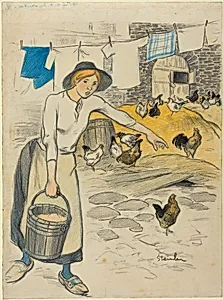
Medium
pen and black ink and colored crayon
Dimensions
overall (approximate): 43.9 x 32.4 cm (17 5/16 x 12 3/4 in.)
Classification
Drawing
Department
CG-E
Museum
National Gallery of Art, Washington, D.C.
Credit
Rosenwald Collection
Accession Number
1943.3.8045
Rights
Public Domain
Art Historical Context
**Fille de Ferme (Farm Girl), 1896** Théophile Alexandre Steinlen's *Fille de Ferme* captures the simple grace of rural life in late 19th-century France. Created in 1896, this drawing depicts a young farm girl, rendered with Steinlen's signature empathy for everyday people. Measuring approximately 43.9 x 32.4 cm, it belongs to the National Gallery of Art's Rosenwald Collection highlighting the artist's prowess in intimate portraiture. Steinlen, a Swiss-born artist active in Paris's Montmartre during the Belle Époque, was renowned for his illustrations in magazines like *Gil Blas* and posters for cabarets such as Le Chat Noir. Associated with Realism and the emerging Art Nouveau, he elevated ordinary subjects—workers, children, and animals—through expressive lines and subtle color. This work reflects his fascination with the humanity in humble lives, bridging urban bohemia and countryside authenticity. The mixed medium of pen and black ink with colored crayon allows for dynamic contrasts: bold ink outlines define form and texture, while crayon adds warmth and depth to flesh tones and fabrics. Such techniques made Steinlen's drawings ideal for reproduction, influencing graphic arts and underscoring the cultural shift toward celebrating the working class in fin-de-siècle Europe. A gem for visitors, it invites reflection on beauty in the ordinary. (198 words)
About the Artist
Théophile Alexandre Steinlen · 1859–1923
Théophile Alexandre Steinlen, born on November 10, 1859, in Lausanne, Switzerland, hailed from a family with artistic roots; his grandfather, Christian Gottlieb Steinlen, was a painter and draftsman. After two years studying theology at the University of Lausanne, he trained in industrial ornamental drawing in Mulhouse under Schoenhaupt and worked as a designer trainee at a textile mill. Encourage...