
Finger Ring
Unknown Artist
7th century
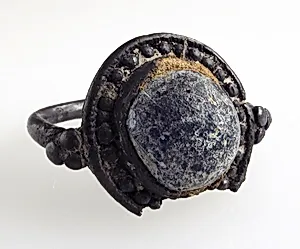
Medium
Silver, glass cabochon
Dimensions
Overall: 1 x 1 x 5/8 in. (2.6 x 2.5 x 1.6 cm) bezel: 11/16 x 5/8 x 1/4 in. (1.7 x 1.6 x 0.7 cm)
Classification
Metalwork-Silver
Culture
Frankish
Department
Medieval Art
Museum
Metropolitan Museum of Art, New York, NY
Credit
Gift of J. Pierpont Morgan, 1917
Accession Number
17.191.100
Rights
Public Domain
Art Historical Context
This delicate 7th-century Frank finger ring, crafted from silver with a glass cabochon bezel, offers a glimpse into the refined metalworking of early medieval Europe. Measuring just 1 x 1 x 5/8 inches overall, its petite form belies the skill involved in shaping the hoop and setting the polished, convex glass stone—a technique that highlighted the gem's luster without faceting, common in pre-Romanesque jewelry. Hailing from the Frankish during the Merovingian era (roughly 481–751 CE), when the Franks dominated much of modern-day France and Germany, this ring likely served as a status symbol for elites. Frankish metalwork blended Germanic traditions with lingering Roman influences, producing items like this for personal adornment, seals, or even betrothal. The silver's purity and the cabochon's vibrant color would have caught the light, signaling wealth amid a turbulent post-Roman world. Now housed in the Metropolitan Museum of Art's Medieval Art Department—thanks to a 1917 gift from J. Pierpont Morgan—this unassuming treasure underscores the artistry of anonymous craftsmen. It reminds us how everyday objects preserved cultural identity through exquisite, enduring techniques.