
Finger Ring
Unknown Artist
7th century
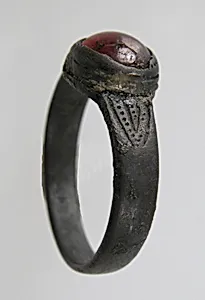
Medium
Silver, garnet or glass paste cabochon
Dimensions
Overall: 7/8 x 13/16 x 1/2 in. (2.3 x 2.1 x 1.2 cm) bezel: 3/8 x 1/4 x 3/16 in. (0.9 x 0.7 x 0.4 cm)
Classification
Metalwork-Silver
Culture
Frankish
Department
Medieval Art
Museum
Metropolitan Museum of Art, New York, NY
Credit
Gift of J. Pierpont Morgan, 1917
Accession Number
17.192.194
Rights
Public Domain
Art Historical Context
This exquisite 7th-century Frank finger ring, crafted from silver with a striking garnet or glass paste cabon, exemplifies the refined metalwork of early medieval Europe. Measuring just 7/8 x 13/16 x 1/2 inches overall, its petite bezel (3/8 x 1/4 x 3/16 inches) highlights the jeweler's skill in setting the smooth, rounded cabochon—a technique that maximized the stone's deep color and luster without faceting, a hallmark of pre-Romanesque craftsmanship. Hailing from the Merovingian Frankish culture, which dominated much of Gaul (modern France and Germany) during the 7th century, this ring likely served as a status symbol for nobility or clergy. Frankish metalworkers were renowned for blending Roman traditions with emerging Germanic styles, using silver for durability and gem-like pastes to mimic precious stones affordably. Such jewelry bridged pagan and Christian worlds, often worn in daily life or as seals. A generous gift from J. Pierpont Morgan in 1917, this piece now graces the Metropolitan Museum of Art's Medieval Art department, offering visitors a tangible glimpse into the opulent yet practical artistry of the early Middle Ages. Its survival underscores the enduring allure of Frankish ingenuity.