
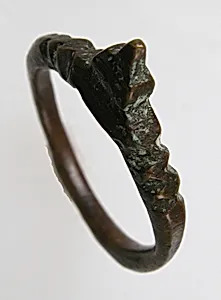
Finger Ring
Unknown Artist
7th century
Medium
Copper alloy
Dimensions
Overall: 1 1/8 x 7/8 x 3/16 in. (2.8 x 2.3 x 0.4 cm)
Classification
Metalwork-Copper alloy
Culture
Frankish
Department
Medieval Art
Museum
Metropolitan Museum of Art, New York, NY
Credit
Gift of J. Pierpont Morgan, 1917
Accession Number
17.192.231
Rights
Public Domain
Art Historical Context
This delicate finger ring, crafted in the 7th by an unknown Frankish artisan, a glimpse into the daily lives of people during the Merovingian period—the early medieval era when the Franks ruled much of what is now France and Germany. Made from copper alloy, a durable and accessible metal, it reflects the practical metalworking traditions blending Roman influences with Germanic craftsmanship. At just over inch in diameter, its size (1 1/8 x 7/8 x 3/16 in.) suggests was worn for personal adornment, perhaps signifying status, betrothal, or simply style among the Frankish elite or emerging nobility. Copper alloy rings like this were produced using techniques such as casting or hammering, allowing for intricate designs despite the material's relative affordability compared to gold or silver reserved for royalty. In Frankish culture, jewelry served both decorative and symbolic roles, often featuring motifs of animals, interlace, or Christian symbols as the region transitioned from paganism to Christianity under kings like Clovis. This ring's survival highlights the skill of medieval metalworkers and the enduring appeal of personal ornaments. Today, it resides in the Metropolitan Museum of Art's Medieval Art department, a gift from J. Pierpont Morgan in 1917, inviting us to ponder the hands that once wore it amid the turbulent 7th-century world.