
Finger Ring
Unknown Artist
7th century
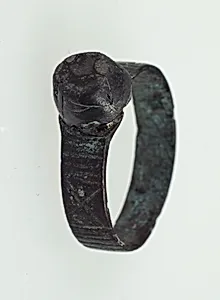
Medium
Silvered Bronze
Dimensions
Overall: 7/8 x 13/16 x 5/16 in. (2.3 x 2 x 0.8 cm) bezel: 5/16 x 3/16 in. (0.8 x 0.5 cm)
Classification
Metalwork-Bronze
Culture
Frankish
Department
Medieval Art
Museum
Metropolitan Museum of Art, New York, NY
Credit
Gift of J. Pierpont Morgan, 1917
Accession Number
17.192.225
Rights
Public Domain
Art Historical Context
This delicate finger ring, crafted in the 7th by an unknown Frankish artisan, the exquisite metalwork of the early Medieval period. Made of silvered bronze—a technique a thin silver layer was applied over bronze to the luster of more precious metals—it measures just 7/8 x 13/16 x 5/16 inches, with a modest bezel of 5/ x 3/16 inches. Such rings were intimate personal adornments, likely worn by members of the Frankish elite during the Merovingian era, a time when the Franks ruled much of what is now France and Germany. In the turbulent 7th century, Frankish society blended Germanic traditions with Roman influences, and jewelry like this served practical and symbolic roles—perhaps as seals, betrothal tokens, or status symbols. The silvering process highlights sophisticated craftsmanship: was cast or hammered into shape, then electroplated or fire-gilded with silver for durability and shine, making luxury accessible beyond gold reserves. This ring reflects the Frankish knack for functional beauty in everyday metalwork. Generously gifted to the Metropolitan Museum of Art by J. Pierpont Morgan in 1917, it offers a tangible glimpse into Merovingian life, bridging the gap between late antiquity and the Carolingian Renaissance. Visitors, imagine slipping it on— a whisper of history on your finger!