
Finger Ring
Unknown Artist
7th century
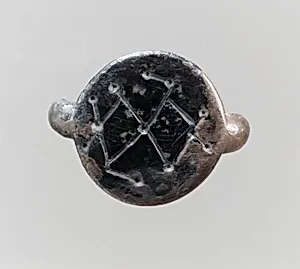
Medium
Silver
Dimensions
Overall: 7/8 x 3/4 x 11/16 in. (2.3 x 1.9 x 1.7 cm) bezel: 11/16 in. (1.7 cm)
Classification
Metalwork-Silver
Culture
Frankish
Department
Medieval Art
Museum
Metropolitan Museum of Art, New York, NY
Credit
Gift of J. Pierpont Morgan, 1917
Accession Number
17.193.71a
Rights
Public Domain
Art Historical Context
This exquisite silver finger ring, crafted by an unknown Frankish artisan in the th century, offers a glimpse into the daily lives and craftsmanship of the Meroving Franks, who dominated much of early medieval Europe. Measuring just 7/8 x 3/4 x 11/16 inches overall, with a bezel of 11/16 inch, its compact form was designed for personal adornment, likely worn by both men and women as a symbol of status or affection. The use of silver—a precious metal worked through techniques like casting and hammering—highlights the sophisticated metalworking skills of Frankish jewelers, who drew on late Roman traditions while developing distinctly Germanic styles. In the turbulent 7th century, as the Frankish kingdoms consolidated power under rulers like Clovis's successors, such rings served practical and cultural roles. They might have sealed documents, marked alliances, or simply expressed wealth amid a Christianizing society blending pagan motifs with emerging Christian iconography. Though details of its decoration are subtle, the ring exemplifies the portability and durability of Frankish metalwork, enduring as a testament to a formative era in European history. A generous gift from J. Pierpont Morgan in 1917, this piece resides in The Metropolitan Museum of Art's Medieval Art Department, inviting visitors to ponder the intimate stories behind these tiny treasures.