
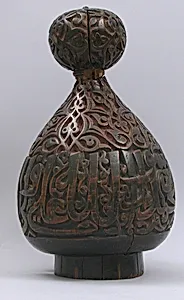
Finial, Possibly from a Cenotaph
Unknown Artist
late 14th–16th century
Medium
Wood; turned and carved with traces of later paint and gilding
Dimensions
H. 13 in. (33 cm) Max. Diam. 7 1/2 in. (19.1 cm)
Classification
Wood
Department
Islamic Art
Museum
Metropolitan Museum of Art, New York, NY
Credit
Louis E. and Theresa S. Seley Purchase Fund for Islamic Art and Rogers Fund, 1988
Accession Number
1988.346
Rights
Public Domain
Tags
Art Historical Context
This elegant wooden finial, possibly crowning a cenotaph empty tomb monument honoring the deceased—dates to the late 14 through 16th century, a vibrant era in Islamic art. Crafted from wood, it showcases masterful turning on a lathe for its smooth, bulbous form and intricate carving that adds delicate patterns and motifs. Traces of later and gilding hint at its original opulent decoration, evoking the splendor of funerary architecture in regions influenced by Arabic traditions, such as Mamluk Egypt or SyriaIn Islamic culture, finials like this served both structural and symbolic roles, often perched atop tomb canopies to ward off evil spirits or signify spiritual elevation. The combination of lathe-turning for precision and hand-carving for ornamentation reflects advanced woodworking techniques prized in the medieval Islamic world, where wood was a favored medium for its workability in mosques, mausolea, and palaces. Acquired by The Metropolitan Museum of Art in 1988 through the Louis E. and Theresa S. Seley Purchase Fund for Islamic Art and Rogers Fund, this artifact invites visitors to ponder the artistry behind everyday sacred objects, bridging craftsmanship and commemoration across centuries.