
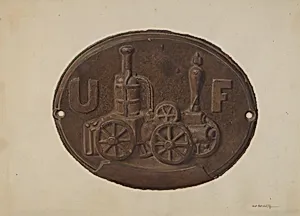
Firemark
1935/1942
Medium
watercolor and graphite on paper
Dimensions
overall: 23.9 x 32.7 cm (9 7/16 x 12 7/8 in.)
Classification
Index of American Design
Department
CG-W
Museum
National Gallery of Art, Washington, D.C.
Credit
Index of American Design
Accession Number
1943.8.10266
Rights
Public Domain
Art Historical Context
**Firemark** by Alfeth, created between 1935 and 1942, is a delicate watercolor and graphite rendering on paper, measuring 23.9 x 32.7 cm. This work captures a historic firemark—a cast iron or lead plaque once affixed to buildings insured by early American fire companies. These emblems, popular from the late 18th to mid-19th centuries, advertised insurers like the Philadelphia Contributionship while serving as markers for volunteer firefighters rushing to the scene. As part of the *Index of American Design*, a Federal Art Project under the Works Progress Administration (WPA), Bruseth's piece documents everyday American folk art during the Great Depression. Launched in 1935 and concluding around 1942, the Index employed artists nationwide to meticulously record regional crafts, furniture, and symbols, preserving cultural heritage amid economic hardship. Over 15,000 such renderings now form a vital archive at the National Gallery of Art. Bruseth's technique shines in the watercolor's vibrant hues—evoking the firemark's original metallic gleam—and precise graphite lines that highlight intricate details like eagles, shields, and lettering. This fusion not only revives a slice of commercial history but underscores America's innovative spirit in fire protection and community safety. A charming window into our past! (198 words)
About the Artist
Alf Bruseth · 1855–present
Alf Bruseth (1898–1974) was born on May 10, 1898, in Silvana, Washington, a small logging community in Snohomish County. As a self-taught artist specializing in watercolor and drawings, Bruseth honed his skills independently before entering the professional art world during the Great Depression. In 1938, he submitted his portfolio to Robert Bruce Inverarity, supervisor of the Federal Art Project i...