
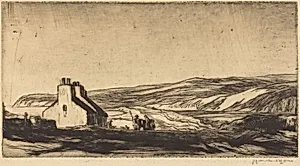
First Study for the Ballantrae Road
1907
Medium
drypoint in black
Dimensions
plate: 9.05 × 17.3 cm (3 9/16 × 6 13/16 in.)
Classification
Department
CG-W
Museum
National Gallery of Art, Washington, D.C.
Credit
Rosenwald Collection
Accession Number
1943.3.1984
Rights
Public Domain
Art Historical Context
Muirhead Bone's *First Study for the Balltrae Road* (1907) invites visitors into the rugged beauty of Scotland's Ayrshire coast. This intimate drypoint print, measuring just 9. × 17.3 cm, captures a preliminary vision of the windswept road near Ballantrae, Bone's keen eye for topography and atmosphere. As a leading British etcher of his time, Bone bridged the 19th-century etching revival with modernist precision, often drawing from direct observation during his travels. The drypoint medium—scratched directly into a copper plate with a steel needle—lends the work its signature velvety texture and rich black tones. Bone's technique produces soft burrs along the lines, evoking the misty Scottish light and undulating landscape with remarkable immediacy. Unlike more mechanical intaglio methods, drypoint's fragility (plates wear quickly) underscores its status as a personal, exploratory study. Housed in the National Gallery of Art's Rosenwald Collection, this print exemplifies early 20th-century printmaking's artistic vitality. Bone's output influenced generations, blending documentary detail with poetic evocation, making *First Study* a gem for appreciating how small-scale works can distill vast natural drama.
About the Artist
Muirhead Bone · 1876–1953
Sir Muirhead Bone was born in Glasgow on March 23, 1876, into a world of shipyards and industrial architecture that would profoundly shape his art. He trained initially in architectural draftsmanship before studying at Glasgow School of Art, developing a draughtsman's eye for structure and mass. He began printmaking in 1898, and though his first known print was a lithograph, he became celebrated a...