
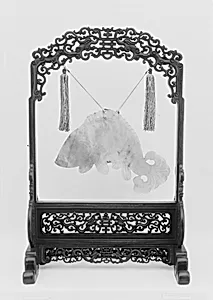
Fish Gong
Unknown Artist
Medium
Jadeite, an intermingling of very translucent gray, blue and green with touches of russet
Dimensions
H. 6 3/4 in. (17.2 cm); W. 9 11/16 in. (24.6 cm); L. 5/16 in. (0.8 cm)
Classification
Jade
Culture & Period
China · Ming dynasty (1368–1644)
Department
Asian Art
Museum
Metropolitan Museum of Art, New York, NY
Credit
Gift of Heber R. Bishop, 1902
Accession Number
02.18.421
Rights
Public Domain
Tags
Art Historical Context
Behold the exquisite *Fish Gong*, a masterful jadeite carving from China's Ming dynasty (13681644). Crafted from highly translucent gray, blue, and greenite accented with subtle russet hues, this thin slab measures just 6 3/4 inches high, 9 11/16 inches wide, and mere 5/16 inch thick—demonstrating the era's unparalleled lapidary. Shaped as a graceful fish, it belongs to the Metropolitan Museum of Art's Asian Art collection, generously gifted by Heber R. Bishop in 1902. In Ming China, jade was revered as the "stone of heaven," symbolizing purity, immortality, and imperial virtue. This gong, classified as a musical instrument, likely served in ceremonial ensembles or rituals, where striking its resonant surface produced a clear, ethereal tone. The fish form evokes abundance and prosperity—its Chinese name *yu* puns with "surplus"—blending artistry with auspicious symbolism. Such objects highlight the dynasty's revival of classical jade traditions, blending Song-era naturalism with intricate, near-translucent polish. Today, the *Fish Gong* captivates with its delicate beauty and technical virtuosity, inviting visitors to ponder the harmony of sound, form, and cultural reverence in imperial China.