
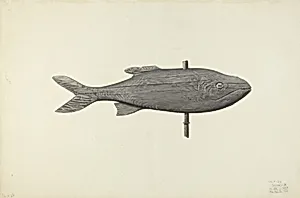
Fish Weather Vane
Medium
watercolor, graphite, and pen and ink on paperboard
Dimensions
overall: 35.9 x 53.7 cm (14 1/8 x 21 1/8 in.)
Classification
Index of American Design
Department
CG-W
Museum
National Gallery of Art, Washington, D.C.
Credit
Index of American Design
Accession Number
1943.8.17302
Rights
Public Domain
Art Historical Context
Behold the *Fish Weather V*, a captivating 1939 rendering by Michael Riccitelli, in watercolor, graphite, and and ink on paperboard35.9 x 53.7 cm). This detailed depiction captures the whimsical form of a traditional American weather vane shaped like a leaping fish, a motif rooted in maritime folklore and New craftsmanship. Riccitelli's precise lines and vibrant washes bring to life the vane's dynamic curves and metallic gleam, evoking the salty breezes of coastal life. Created as part of the Index of American Design—a Works Progress Administration (WPA) project from 1935 to 1942—this artwork exemplifies a national effort to document and celebrate everyday American folk art during the Great Depression. Housed in the National Gallery of Art's collection, it preserves vanishing examples of vernacular design, highlighting how ordinary objects like weather vanes served both practical and symbolic purposes, pointing the way through changing winds and seasons. Riccitelli's mixed-media technique masterfully blends the fluidity of watercolor for texture and depth with the sharp accuracy of ink and graphite for intricate details, making this not just a record but a work of art in its own right. A charming window into America's cultural heritage, it reminds us how functional folk objects embody regional pride and ingenuity.
About the Artist
Michael Riccitelli · 1855–present
**Michael Riccitelli** (American, active c. 1935) was a skilled draftsman whose precise watercolor renderings captured the essence of American folk art during the Great Depression era. Little is known about his early life or formal training, as biographical details remain scarce. He gained prominence through his contributions to the Index of American Design (IAD), a Works Progress Administration (...