
Fish Weather Vane
c. 1939
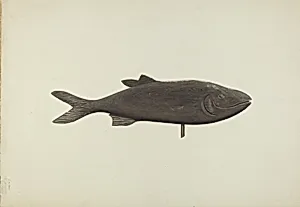
Medium
watercolor and graphite on paperboard
Dimensions
overall: 37.7 x 55.8 cm (14 13/16 x 21 15/16 in.) Original IAD Object: 40" wide
Classification
Index of American Design
Department
CG-W
Museum
National Gallery of Art, Washington, D.C.
Credit
Index of American Design
Accession Number
1943.8.16313
Rights
Public Domain
Art Historical Context
Behold the *Fish Weather Vane*, captivating watercolor and graphite rendering by artist Michael Riccitelli, around 1939. Measuring 37.7 x 55.8 cm, this delicate work on paperboard captures the whimsical form of a traditional American folk art weather vane—depicting a sleek fish poised to swivel with the wind. Riccitelli's precise graphite lines define the vane's contours and scales, while vibrant watercolors bring its metallic sheen and nautical flair to life, showcasing his skill in rendering three-dimensional objects with lifelike texture. This piece is a gem from the Index of American Design, a landmark WPA Federal Art Project from the 1930s that employed artists to document everyday American crafts and folk art amid the Great Depression. By faithfully reproducing objects like this 40-inch-wide weather vane, Riccitelli helped preserve vanishing traditions of handcrafted Americana, from maritime symbols to rural ingenuity. Weather vanes, often crowning barns and steeples, blended functionality with fanciful design, reflecting regional pride—here, perhaps evoking coastal fishing heritage. Displayed at the National Gallery of Art, *Fish Weather Vane* invites us to appreciate how such documentation safeguarded cultural heritage, bridging art, history, and the American spirit of resourcefulness.
About the Artist
Michael Riccitelli · 1855–present
**Michael Riccitelli** (American, active c. 1935) was a skilled draftsman whose precise watercolor renderings captured the essence of American folk art during the Great Depression era. Little is known about his early life or formal training, as biographical details remain scarce. He gained prominence through his contributions to the Index of American Design (IAD), a Works Progress Administration (...