
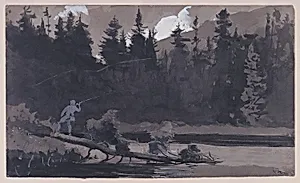
Fisherman in Quebec, Canada
Classification
landscapes
Department
Smithsonian Collection
Museum
Smithsonian American Art Museum
Credit
Gift of Charles Savage Homer, Jr.
Accession Number
1912-12-89
Rights
Public Domain
About this artwork
A fisherman, standing on a fallen tree trunk, casts his rod into the water. A dense forest of fir trees fills the middleground and distant mountains can be seen in the background.
Art Historical Context
Winslow Homer, one of America's foremost Realist painters, captured the rugged beauty of Quebec's wilderness in *Fisherman in Quebec, Canada* (1895). Standing on a fallen tree trunk, the solitary fisherman casts his rod into shimmering water, embodying the quiet determination of those who commune with nature. Dense fir forests dominate the middle ground, while distant mountains fade into the horizon, creating a layered composition that draws the viewer into the vast, untamed landscape. Created during Homer's late career, when he increasingly sought inspiration in remote locales like Quebec's remote waters, this work reflects his mastery of Realism. Homer, born in 1836, evolved from Civil War illustrations to evocative depictions of everyday heroes battling the elements. His precise brushwork and dramatic spatial depth highlight humanity's harmony—and tension—with the natural world, a theme central to American art at the turn of the century. Though the medium is unknown, Homer's signature style evokes the crisp air and solitude of the Canadian north. Now in the Smithsonian American Art Museum as a gift from Charles Savage Homer, Jr., this landscape invites visitors to ponder the timeless allure of fishing as both livelihood and meditation, a nod to 19th-century exploration of North America's wild frontiers.