
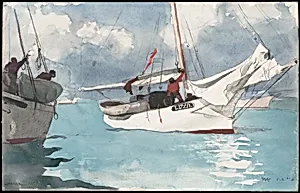
Fishing Boats, Key West
1903
Medium
Watercolor and graphite on off-white wove paper
Dimensions
13 15/16 x 21 3/4 in. (35.4 x 55.2 cm) Framed: 24 1/2 x 30 1/2 in. (62.2 x 77.5 cm)
Classification
Watercolor
Culture
American
Department
The American Wing
Museum
Metropolitan Museum of Art, New York, NY
Credit
Amelia B. Lazarus Fund, 1910
Accession Number
10.228.1
Rights
Public Domain
Tags
Art Historical Context
Winslow Homer's *Fishing Boats, Key* (1903) captures the vibrant coastal life of Florida's Key West, a favorite late-career destination for the artist. By 1903, Homer, a towering figure in American Realism, had shifted much of his focus to watercolor, moving away from his earlier oil paintings of Civil War scenes and Adirondack hunts. This work reflects his fascination with the sea's raw power and the hardy lives of fishermen, rendered with a keen eye for light and movement amid the tropical waters. Executed in watercolor and graphite on off-white wove paper (13 15/16 x 21 3/4 in.), the piece showcases Homer's masterful command of the medium. Watercolor's transparency allowed him to layer translucent hues, evoking the shimmering blues and greens of the ocean and the boats' weathered forms. Graphite adds precise outlines, enhancing the spontaneity and atmospheric effects that define his mature style—often painted en plein air to seize fleeting marine conditions. Housed in The Metropolitan Museum of Art's American Wing, this artwork exemplifies Homer's enduring influence on American art, bridging 19th-century naturalism with modernist directness. Acquired through the Amelia B. Lazarus Fund in 1910, it invites visitors to ponder the timeless rhythm of work on the water, a nod to America's maritime heritage.
About the Artist
Winslow Homer · 1836–1910
Winslow Homer (1836-1910) was one of America's greatest painters and a preeminent figure in 19th-century American art. Largely self-taught, Homer began his career as a commercial illustrator and Civil War correspondent for Harper's Weekly before becoming renowned for his powerful marine subjects and landscape paintings. His mastery of both oil and watercolor, combined with his uncompromising reali...