
Fishing Boats on the Beach in Winter
mid to late 19th century
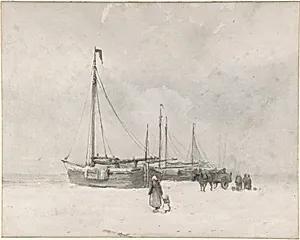
Medium
Black chalk, watercolor, some white bodycolor; framing lines in black chalk
Dimensions
12-13/16 x 16-1/16 in. (32.5 x 40.8 cm)
Classification
Drawings
Department
Drawings and Prints
Museum
Metropolitan Museum of Art, New York, NY
Credit
Purchase, Wildenstein & Co. Inc., Susan H. Seidel, and Jill Newhouse Gifts, 2000
Accession Number
2000.106
Rights
Public Domain
Tags
Art Historical Context
Anton Mauve, a leading figure in the Dutch Hague School during the mid- to late 19th century masterfully captured the rugged beauty of everyday life in the Netherlands with *Fishing Boats on the in Winter*. This intimate drawing evokes the harsh yet poetic reality of coastal fishermen, likely depicting horses hauling boats across a windswept winter beach—a common sight in the dunes near Scheveningen, where Mauve often worked. The Hague School's emphasis on naturalism and atmospheric effects shines here, portraying the muted tones of a cold season without romantic idealization. Rendered in black chalk, watercolor, and touches of white bodycolor on a modest 12-13/16 x 16-1/16 inch sheet, the work highlights Mauve's skill in mixed-media drawings. These techniques allowed for subtle gradations of gray skies, frosty sands, and the sturdy forms of boats and horses, creating a sense of immediacy and depth. Framing lines in black chalk add a refined finish, suggesting it may have been a finished study rather than a mere sketch. Acquired by the Metropolitan Museum of Art in 2000, this piece exemplifies Mauve's influence on Realism, bridging Dutch landscape traditions with emerging Impressionist interests in light and mood. Visitors will appreciate its quiet drama, a window into 19th-century maritime labor and the enduring allure of wintry seascapes.
About the Artist
Anton Mauve · 1838–1888
Anton Mauve (1838–1888), born Anthonij Rudolf Mauve in Zaandam, Netherlands, hailed from a family of North Holland clergymen. At age 16, he apprenticed under animal painter Pieter Frederik van Os in Haarlem, mastering depictions of livestock, before studying briefly with Wouterus Verschuur, whose equine subjects instilled a lifelong affinity for horses. He honed his plein air technique alongside P...