
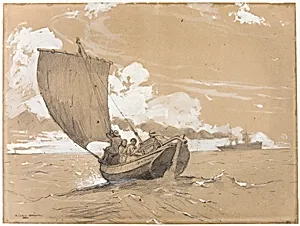
Fishing off Scarborough
1882
Medium
Graphite and opaque white watercolor, with traces of black chalk, on medium weight, slightly-textured, tan laid paper with blue and red fibers
Dimensions
46.2 × 61.8 cm (18 1/4 × 24 3/8 in.)
Classification
graphite
Department
Prints and Drawings
Museum
Art Institute of Chicago
Accession Number
16788
Rights
Public Domain
About this artwork
During Homer’s sojourn in England from 1881 to 1882, he rented a studio on a cliff overlooking Cullercoats Harbor, where he observed the comings and goings of fishing boats. Fishing Off Scarborough shows two young women and two fishermen in a coble as it slices through coastal waters. Carefully rendered in graphite, the figures and fishing boat stand in contrast to Homer’s spontaneous, abstract representation of clouds, mist, and spray done in opaque white watercolor. In addition to employing gr...
Art Historical Context
**Fishing off Scarborough** (1882) by Winslow Homer captures the rugged drama of coastal life, a recurring theme in the artist's oeuvre. Created during Homer's stay in Scarborough, England—a fishing village on the North Sea coast—this drawing depicts fishermen braving turbulent waters, reflecting his fascination with the perilous bond between man and sea. Homer, a leading American Realist, honed his skills observing everyday laborers, infusing his works with raw authenticity and emotional depth. Rendered in graphite with opaque white watercolor and traces of black chalk on tan laid paper, the piece showcases Homer's masterful drawing techniques. The medium-weight, textured support with blue and red fibers allowed for dynamic layering, where graphite sketches the forms and white watercolor heightens highlights against dark waves. At 46.2 × 61.8 cm, it's an intimate study, likely preparatory for larger oils or watercolors, highlighting Homer's shift toward luminous, high-contrast effects that defined his later career. Housed in the Art Institute of Chicago's Prints and Drawings department, this work underscores Homer's international influences and enduring legacy. It invites visitors to ponder the timeless resilience of working people amid nature's fury, bridging 19th-century American Realism with universal human stories.
About the Artist
Winslow Homer · 1836–1910
Winslow Homer (1836-1910) was one of America's greatest painters and a preeminent figure in 19th-century American art. Largely self-taught, Homer began his career as a commercial illustrator and Civil War correspondent for Harper's Weekly before becoming renowned for his powerful marine subjects and landscape paintings. His mastery of both oil and watercolor, combined with his uncompromising reali...