
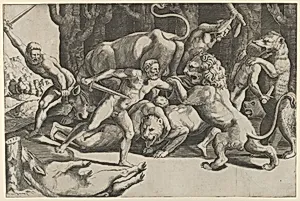
Five men fighting beasts, at lower left is a fallen boar
Medium
Engraving
Dimensions
Sheet: 11 in. × 16 9/16 in. (28 × 42 cm)
Classification
Prints
Department
Drawings and Prints
Museum
Metropolitan Museum of Art, New York, NY
Credit
The Elisha Whittelsey Collection, The Elisha Whittelsey Fund, 1949
Accession Number
49.97.339
Rights
Public Domain
Tags
Art Historical Context
This dynamic engraving, created in 1532 by the anonymous printmaker known as the Master of the Die after design by Giulio Romano, captures a dramatic scene of five muscular men battling wild beasts including a fallen boar at the lower left. Giulio Romano, a leading Mannerist artist and former pupil of Raphael, was celebrated for his energetic compositions and heroic male figures, which the engraver translated into intricate line work. The medium of engraving allowed such designs to circulate widely, bringing Renaissance ideals of strength and classical drama to audiences beyond Italy. Measuring roughly 11 by 16 ½ inches, the print highlights the period’s fascination with ancient myths and heroic struggles, evoking themes of courage against nature’s ferocity. The prominent display of swords and male nudes reflects the Renaissance revival of classical anatomy and movement, rendered with the fine cross-hatching typical of 16th-century engraving techniques. Housed in the Metropolitan Museum of Art’s Drawings and Prints department as part of the Elisha Whittelsey Collection, the work exemplifies how prints preserved and popularized the bold visual language of Mannerism for generations of viewers.
About the Artist
Master of the Die|Giulio Romano · 1525–1560
**Master of the Die** (fl. 1525–1560) was an anonymous Italian engraver and printmaker active primarily in Rome during the mid-16th century. Named for the distinctive small die he used to sign his prints—a tiny emblematic mark that became his moniker—this elusive artist remains unidentified despite scholarly proposals linking him to figures like Benedetto Verino, Giovanni Francesco Zabello, Tommas...