
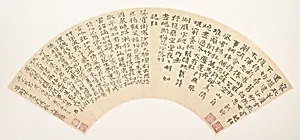
清 石濤 (朱若極) 楷書七律五首 折扇|Five poems
ca. 1700
Medium
Folding fan mounted as an album leaf; ink on paper
Dimensions
6 7/8 x 17 1/2 in. (17.5 x 44.5 cm)
Classification
Calligraphy
Culture & Period
China · Qing dynasty (1644–1911)
Department
Asian Art
Museum
Metropolitan Museum of Art, New York, NY
Credit
Bequest of John M. Crawford Jr., 1988
Accession Number
1989.363.152
Rights
Public Domain
Art Historical Context
This exquisite calligraphy by Shitao (also known as Zhu Ruoji, 1642–1707) captures five seven-character regulated poems written in elegant regular script on a folding fan. Created around 1700 during the Qing dynasty, the work reflects the artist’s life as a former Ming prince who became a Buddhist monk and later an itinerant painter and calligrapher. Shitao belonged to a circle of individualist artists who rejected rigid academic traditions, favoring expressive brushwork that conveyed personal emotion and philosophical depth. The piece’s format—a fan mounted as an album leaf—highlights the intimate nature of Chinese calligraphy, often created for private appreciation or as gifts among scholars. Ink on paper allows the varying pressure and speed of the brush to produce lively, rhythmic characters that seem to dance across the surface. Though small in scale, measuring just under seven inches high, the work demonstrates Shitao’s mastery of structure and spacing, turning poetic verses into a visual experience. Today in the Metropolitan Museum of Art, this fan offers visitors a window into late-imperial Chinese culture, where poetry, calligraphy, and painting were seen as unified arts expressing the cultivated mind.