
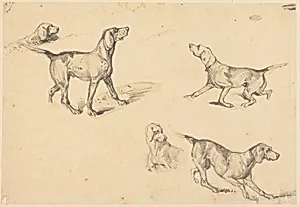
Five Studies of a French Pointer
1825/1826
Medium
graphite with touches of gray wash on wove paper
Dimensions
sheet: 14 x 20.6 cm (5 1/2 x 8 1/8 in.)
Classification
Drawing
Department
CG-E
Museum
National Gallery of Art, Washington, D.C.
Credit
Joseph F. McCrindle Collection
Accession Number
2009.70.46
Rights
Public Domain
Art Historical Context
Richard Parkes Bonington created this delicate sheet of graphite studies around 1825–1826 while living in France, where he immersed himself in the Romantic movement’s emphasis on direct observation of nature. Though best known for luminous landscapes and watercolors, Bonington frequently turned his attention to animals, using quick sketches to record movement and character. The five views of a French Pointer reveal his keen eye for the breed’s alert posture, silky coat, and expressive head—qualities prized by sporting artists of the period. Executed in graphite with subtle gray wash on wove paper, the drawing demonstrates Bonington’s economical yet sensitive technique. Light hatching defines musculature and fur texture, while faint washes suggest volume and the play of light across the dog’s body. Such studies were often preparatory, helping the artist transfer vitality from life into finished paintings destined for the Paris Salon or British exhibitions. Today the sheet offers visitors an intimate glimpse of an artist at work, capturing both the affectionate bond between hunter and dog and the nineteenth-century fascination with empirical study of the natural world. Its modest size and spontaneous lines invite close looking, rewarding viewers who linger on the subtle shifts in pose that bring the pointer to life on the page.
About the Artist
Richard Parkes Bonington · 1802–1828
Richard Parkes Bonington (1802–1828) was a British painter and watercolorist who, despite dying at the age of twenty-five, produced a body of work that had a profound and lasting influence on French and British painting. Born in Arnold, near Nottingham, he moved with his family to Calais and then Paris in 1817, where he studied at the École des Beaux-Arts under Antoine-Jean Gros and copied Old Mas...