
Flagon
19th century, after 1606 original
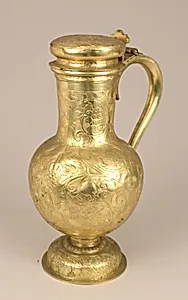
Medium
Silver on base metal
Dimensions
Height: 12 1/2 in. (31.8 cm)
Classification
Metalwork-Electrotype
Culture
British, Birmingham, after British, London original
Department
European Sculpture and Decorative Arts
Museum
Metropolitan Museum of Art, New York, NY
Credit
Gift of Henry G. Marquand, 1883
Accession Number
83.18.21
Rights
Public Domain
Art Historical Context
This elegant flagon, a 19th-century electrotype reproduction by the Birmingham firm Elkington & Co., faithfully recreates a lavish 1606 original from London. Standing at 12½ inches tall, it exemplifies Jacobean metalwork with its ornate silver-on-base-metal surface, capturing the grandeur of early 17th-century British craftsmanship. Flagons like this were prized vessels for serving wine or ale during banquets and ecclesiastical rites, symbolizing status and hospitality in Tudor-Stuart England. Elkington & Co., pioneers of electroplating in the Industrial Revolution, revolutionized decorative arts by using electrolysis to deposit a thin silver layer over base metal. This technique allowed precise replication of intricate details—from embossed motifs to chased designs—at a fraction of the cost of solid silver, making historical treasures accessible to a wider audience. Produced in Birmingham, Britain's metalworking hub, it reflects Victorian fascination with medieval and Renaissance revivalism. Now in the Metropolitan Museum of Art's European Sculpture and Decorative Arts collection, thanks to a gift from Henry G. Marquand in 1883, this flagon highlights the intersection of innovation and tradition. It invites us to appreciate how 19th-century technology preserved the artistry of the past for future generations.
About the Artist
Elkington & Co. · 1829–1963
Elkington & Co. was the Birmingham firm that transformed the production of decorative metalwork by commercializing electroplating — a process that made silver-quality objects accessible to a vastly wider public. The company was established by George Richards Elkington (1801–1865) and his cousin Henry Elkington during the 1830s, initially trading as G. R. Elkington & Co. A crucial turning point cam...