
Flagon
ca. 1765
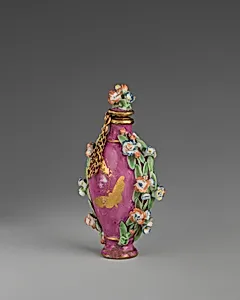
Medium
Soft-paste porcelain
Dimensions
3 1/4 × 1 5/8 in. (8.3 × 4.1 cm)
Classification
Ceramics-Porcelain
Culture
British, Chelsea
Department
European Sculpture and Decorative Arts
Museum
Metropolitan Museum of Art, New York, NY
Credit
Gift of Irwin Untermyer, 1964
Accession Number
64.101.631a, b
Rights
Public Domain
Tags
Art Historical Context
This delicate flagon, crafted by the renowned Chelsea Porcelain Manufactory around 1765, exemplifies golden age of British porcelain production. Established in 1743 Chelsea was one of England's pioneering factories, specializing in soft-paste porcelain refined, translucent material that mimicked the coveted hard-paste porcelain from China and Saxony's Meissen works. At just 3¼ × 1⅝ inches, this petite vessel was likely designed for personal use, such as holding scents, oils, or small libations, reflecting the opulent tastes of 18th-century aristocracy. Adorned with vibrant motifs of butterflies and flowers—hallmarks of the Rococo style—the flagon showcases the factory's mastery of hand-painted enamels and gilding techniques. These naturalistic designs, applied over glaze and fired at low temperatures, captured the era's fascination with nature's fleeting beauty, symbolizing elegance and whimsy. Chelsea's "Gold Anchor" period (c. 1756–1770), to which this piece belongs, marked peak innovation, blending technical prowess with artistic flair. Today, housed in the Metropolitan Museum of Art's European Sculpture and Decorative Arts Department as a gift from Irwin Untermyer in 1964, this flagon invites us to appreciate how porcelain bridged cultures, fueling Britain's industrial and artistic ambitions during the Enlightenment. A tiny treasure of Georgian refinement!
About the Artist
Chelsea Porcelain Manufactory · 1744–1784
**Chelsea Porcelain Manufactory** The Chelsea Porcelain Manufactory, Britain's pioneering porcelain enterprise, was founded around 1743 in Chelsea, London, by two Huguenot silversmiths: Nicholas Sprimont from Liège and Charles Gouyn. Sprimont, trained in Paris as a goldsmith before immigrating to England, brought his expertise in luxury metalwork to the venture, while Gouyn handled early sales th...