
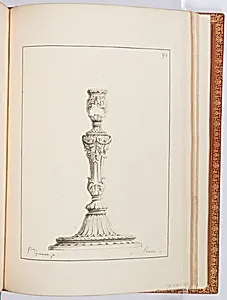
Flambeau de toilette
Classification
Department
Smithsonian Collection
Museum
Smithsonian American Art Museum
Credit
Purchased for the Museum by the Advisory Council
Accession Number
1921-6-313-91
Rights
Public Domain
About this artwork
Research in Progress
Art Historical Context
**Flambeau de Toilette is a delicate 1748 print by Pierre Germain, a masterful French engraver and gold (1703–1783). The title translates to "Toilet," suggesting an elegant design for a dressing-table candelabrum or lamp, emblematic of the refined personal grooming rituals of 18th-century European aristocracy. Acquired by the Smithsonian American Art Museum through its Advisory Council, this work highlights Germain's expertise in creating intricate patterns for luxury metalwork. Created during the height of the Rococo era in France, the print exemplifies the movement's playful asymmetry, scrolling motifs, and lavish ornamentation. As an engraver, Germain specialized in *oeuvre d'orfevrerie*—designs for silversmiths and jewelers—bridging fine art and craftsmanship. Prints like this served as blueprints for opulent objects, disseminating sophisticated styles from royal workshops to elite workshops across Europe. Though research continues, *Flambeau de Toilette* offers a window into the cultural splendor of Louis XV's court, where such toilette accessories symbolized status and indulgence. Its presence in an American collection underscores the transatlantic appeal of French decorative arts, inviting us to appreciate the artistry behind everyday luxury.