
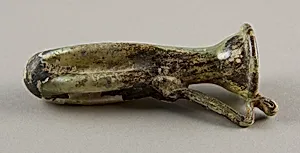
Flask
3rd century
Medium
Glass, blown technique
Dimensions
14 × 5.7 × 5.7 cm (5 1/2 × 2 1/4 × 2 1/4 in.)
Classification
glass
Department
Arts of Greece, Rome, and Byzantium
Museum
Art Institute of Chicago
Accession Number
62075
Rights
Public Domain
Art Historical Context
This delicate flask, crafted by ancient Roman artisans in the 3rd century CE, the ingenuity of Roman glassmaking during the late Roman Empire. Measuring just 14 × 5.7 × 5.7 cm, its petite, bulbous form was ideal for holding perfumes, oils, or—essentials of daily life and personal grooming in a bustling imperial world. Housed in the Art Institute of Chicago's Department of Arts of Greece, Rome and Byzantium, it reflects the era's blend of functionality and subtle elegance. The flask's creation via the blown-glass technique marks a revolutionary Roman innovation, developed around the 1st century BCE in the eastern Mediterranean. By blowing molten glass through a tube, artisans could produce thin-walled, lightweight vessels quickly and affordably, democratizing luxury items once reserved for the elite. This flask's even walls and smooth contours showcase masterful control over the viscous medium, fired in specialized furnaces. Such objects highlight Rome's vast trade networks, with glass from Syrian and Egyptian workshops circulating empire-wide. For visitors, this unassuming flask offers a tangible glimpse into ancient routines, where beauty enhanced the everyday.
About the Artist
Ancient Roman
The artists attributed to "Ancient Roman" in museum collections represent the anonymous craftsmen who produced the vast output of sculpture, frescoes, mosaics, and reliefs defining Roman visual culture from the Republic (c. 509–27 BCE) to the late Empire (c. 395 CE). Individual identities remain elusive, as Roman makers were typically viewed as skilled tradesmen—often enslaved Greeks or provincial...