
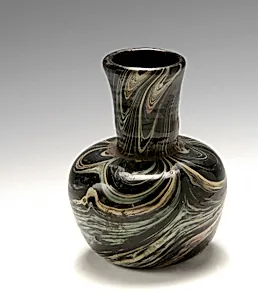
Flask
1st-4th century AD
Medium
Decorative Arts-Glass
Classification
Decorative Arts-Glass
Department
Smithsonian Collection
Museum
Smithsonian American Art Museum
Credit
Smithsonian American Art Museum, Gift of John Gellatly
Accession Number
1929.8.174.5
Rights
Public Domain
About this artwork
Most of the glass vessels in this case date from the first century BC to the fourth century AD. Early glass vessels were made in the Middle East and Egypt using the core-forming technique, in which molten glass was poured over a clay core and decorated with threads of colored glass. During the first century AD, Rome became the center of glassmaking, and the invention of blown glass led to new methods, including free-blown glass, which could be decorated by pinching, rolling, or dragging the surf...
Art Historical Context
This elegant Roman flask, dating from the 1st to 4th century AD, exemplifies the artistry of ancient glassmaking during the height of the Roman Empire. Rome became the epicenter of the craft around the 1st century, glass production exploded in innovation, shifting from earlier Middle Eastern and Egyptian core-forming methods—where molten glass was draped over a clay core and trailed with colorful threads—to revolutionary blowing techniques. These allowed for lighter, more affordable vessels that graced Roman homes, banquets, and tombs. The flask likely showcases free-blown or mold-blown glass, where gatherers of molten glass inflated shapes by blowing through a tube, then pinched, rolled, or dragged surfaces for texture. Romans pioneered stratified glass, fusing multicolored canes, and millefiori ("thousand flowers"), slicing patterned rods for mosaic-like effects. Many such pieces, including this one from the Smithsonian American Art Museum's collection (gift of John Gellatly), acquired a shimmering iridescence over centuries buried in damp tombs—a poetic testament to their use in elite burials. As everyday luxuries turned status symbols, these flasks highlight Rome's technological prowess and aesthetic flair, bridging utility and beauty in the ancient world.