
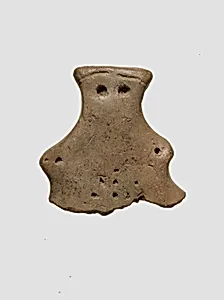
Flat figure
Unknown Artist
ca. 3000 BCE
Medium
Ceramic
Dimensions
1.61 x 1.57 x 0.31 in. (4.09 x 3.99 x 0.79 cm)
Classification
Ceramics-Sculpture
Period
Early Bronze Age
Department
Ancient Near Eastern Art
Museum
Metropolitan Museum of Art, New York, NY
Credit
Gift of Marion A. Nosser, 1978
Accession Number
1978.146
Rights
Public Domain
Art Historical Context
This delicate "Flat figure," crafted from ceramic around 3000 BCE, exemplifies the minimalist artistry of the Early Bronze Age in the Near East. Measuring just 1.61 x 1.57 x 0.31 inches, its flat, plaque-like form suggests a hand-modeled sculpture, possibly representing a stylized human—perhaps a deity, ancestor, or fertility symbol. Such small votive objects were common in emerging urban societies like those in Mesopotamia and the Levant, where clay was abundant and accessible for everyday ritual use. Artistically, the figure's simplicity highlights early sculptural techniques: pinching and smoothing unfired or low-fired clay to create a schematic silhouette, emphasizing silhouette over intricate detail. This reflects a cultural shift toward symbolic representation amid the Bronze Age's technological advances, including early metallurgy and city-building. These artifacts offer glimpses into prehistoric beliefs, likely placed in household shrines or graves to invoke protection or prosperity. On view in the Metropolitan Museum of Art's Ancient Near Eastern Art department (Gift of Marion A. Nosser, 1978), this piece invites us to ponder the lives of anonymous artisans whose modest creations bridged the Neolithic and urban eras.