
Flat Needle
Unknown Artist
1st–4th century
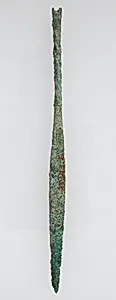
Medium
Copper alloy
Dimensions
Overall: 4 3/16 x 1/4 x 1/16 in. (10.7 x 0.6 x 0.2 cm)
Classification
Metalwork-Bronze
Culture
Roman
Department
Medieval Art
Museum
Metropolitan Museum of Art, New York, NY
Credit
Gift of J. Pierpont Morgan, 1917
Accession Number
17.193.5
Rights
Public Domain
Art Historical Context
Nestled in the Metropolitan Museum of Art's Medieval Art collection, this delicate *Flat Needle* hails from Roman culture of the 1st–4th century CE. Crafted from copper alloy—a material often referred to as bronze—this slender tool measures just 4 3/16 inches long, highlighting the precision of ancient metalworking. Donated by J. Pierpont Morgan in1917, it exemplifies the everyday artifacts that reveal the ingenuity of Roman daily life. Roman bronze metalwork was renowned for its durability and versatility, with needles like this one essential for sewing clothing, leather goods, or even sails on ships. The flat, needle-like form suggests it was forged or cast to pierce tough fabrics efficiently, showcasing advanced techniques in alloying copper with tin for strength and corrosion resistance. Though utilitarian, such objects underscore the Romans' mastery of small-scale production, likely made in workshops across the empire. This unassuming piece offers a window into the practical world of antiquity, reminding us that art and craft intertwined in Roman society. Visitors can appreciate how even humble tools embodied cultural values of functionality and fine craftsmanship.