
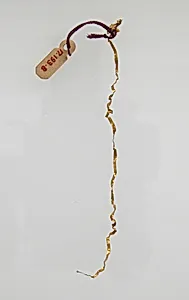
Flattened Wire
Unknown Artist
7th century
Medium
Gold
Dimensions
Overall: 2 5/8 x 1/16 in. (6.7 x 0.1 cm)
Classification
Metalwork-Gold
Culture
Frankish
Department
Medieval Art
Museum
Metropolitan Museum of Art, New York, NY
Credit
Gift of J. Pierpont Morgan, 1917
Accession Number
17.193.8
Rights
Public Domain
Art Historical Context
Behold this delicate fragment known as *Flattened Wire*, a to the exquisite metalworking skills of 7th-century Frankish. Crafted from pure gold and measuring just 2⅝ × 1/16 inches (6.7 × 0.1 cm), this slender strip exemplifies the precision of early medieval goldsmiths. Housed in the Metropolitan Museum of Art's Medieval department—generously gifted by J. Pierpont Morgan in 1917—it offers a glimpse into the opulent world of the Merovingian Franks, who ruled much of western Europe during this era. In Frankish culture, gold was prized for its symbolic power, often adorning jewelry, religious artifacts, and elite personal items. This piece likely served as a component in larger creations, such as brooches, rings, or cloisonné decorations, where flattened wires formed intricate patterns or borders. The technique of hammering and drawing gold into such thin, uniform profiles highlights advanced metallurgical knowledge, blending utility with artistry amid the transition from late antiquity to the Middle Ages. Though its complete original context remains a mystery due to its unknown artist, *Flattened Wire* captivates with its humility and sophistication—reminding us that even the smallest artifacts carry the echoes of a vibrant, innovative society.