
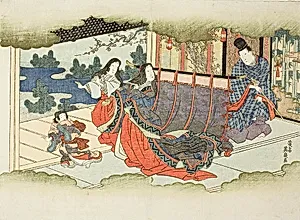
Fleeing from the Samurai
19th century
Medium
Color woodblock print
Dimensions
22 × 29.5 cm (8 11/16 × 11 5/8 in.)
Classification
woodblock print
Department
Arts of Asia
Museum
Art Institute of Chicago
Accession Number
81290
Rights
Public Domain
Art Historical Context
**Fleeing from the Samurai** is a dynamic 19th-century colorblock print by Keis Eisen (1790–1848), a master of the ukiyo-e tradition—"pictures of the floating world"—that captured the vibrant, ephemeral life of Edo-period Japan (1603–1868). just 22 × 29.5 cm, this intimate work from the Art Institute of Chicago's Arts of Asia collection likely depicts a tense moment of escape, blending drama with the everyday heroism often seen in kabuki theater or historical tales. Eisen, renowned for his bijin-ga (images of beautiful women) and genre scenes, infuses the print with expressive figures frozen in motion, evoking the samurai era's rigid social codes and fleeting dangers. The medium of color woodblock printing, or nishiki-e ("brocade pictures"), was revolutionary for its time. Artisans carved multiple wooden blocks—one for each color—allowing affordable mass production of richly hued images that brought art to the masses beyond elite patrons. Eisen's precise lines and subtle gradations of color heighten the narrative tension, showcasing ukiyo-e's technical brilliance and cultural role in democratizing visual storytelling. Held in the Art Institute of Chicago, this print offers a window into Japan's artistic golden age, where woodblocks preserved the thrill of urban life and legend for generations. A perfect gem for contemplating history's dramatic escapes! (198 words)
About the Artist
Keisai Eisen · 1790–1848
Keisai Eisen (1790–1848), born Ikeda Yoshinobu in Edo (modern Tokyo), emerged as one of the late Edo period's most prolific ukiyo-e masters. The son of the renowned calligrapher and Kanō-school painter Ikeda Shigeharu, Eisen was immersed in the arts from childhood. He apprenticed under Kanō Hakkeisai, adopting the art name "Keisai" in homage to his teacher, and later studied bijin-ga (images of be...