
Flint Lock
c. 1941
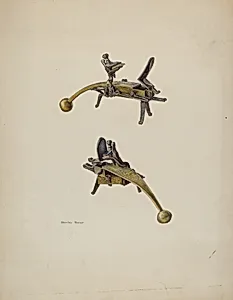
Medium
watercolor, graphite, and colored pencil on paperboard
Dimensions
overall: 45.8 x 35.3 cm (18 1/16 x 13 7/8 in.)
Classification
Index of American Design
Department
CG-W
Museum
National Gallery of Art, Washington, D.C.
Credit
Index of American Design
Accession Number
1943.8.10313
Rights
Public Domain
Art Historical Context
**Flint Lock** by Stanley Mazur created around 1941, is a meticulous rendering in watercolor, graphite, and pencil on paperboard, 45.8 x 35.3 cm. This work belongs to the Index of American Design, a WPA Federal Art Project from the 1930s and early 1940s that artists to document everyday American objects, crafts, and folk art through precise, colorful illustrations. Mazur's piece captures the intricate mechanics of a flintlock—a key firearm component from the 17th to 19th centuries—highlighting its gleaming metal parts and functional elegance. The Index aimed to celebrate and preserve America's cultural heritage during the Great Depression, turning utilitarian objects into artistic treasures. Flintlocks powered muskets used in pivotal moments like the Revolutionary War, symbolizing early American ingenuity and self-reliance. Mazur's technique blends photorealistic graphite detailing with vibrant watercolors and colored pencil accents, creating a luminous, almost three-dimensional quality that invites viewers to appreciate the gunsmith's craftsmanship. Displayed in the National Gallery of Art, this artwork bridges history and art, reminding us how everyday tools shaped a nation. It's a testament to the era's artistic patriotism and the enduring value of design documentation.
About the Artist
Stanley Mazur · 1903–1978
**Stanley Mazur (1903–1978)** was an American artist best known for his meticulous watercolor renderings created as part of the Index of American Design, a Works Progress Administration (WPA) initiative during the Great Depression era. This ambitious project commissioned artists across the United States to document everyday folk art objects, crafts, and tools that embodied the nation's cultural he...