
Flirting Lovers
c. 1673/81
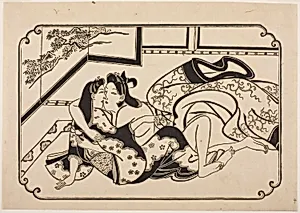
Medium
Woodblock print; sumizuri-e, oban yoko-e
Dimensions
27.1 × 38.4 cm (10 11/16 × 15 1/8 in.)
Classification
woodblock print
Department
Arts of Asia
Museum
Art Institute of Chicago
Accession Number
130213
Rights
Public Domain
Art Historical Context
Hishikawa Moronobu's *Flirting Lovers* (c. 1673/81) captures a playful moment of courtship in Japan's vibrant Edo period, rendered in the pioneering style of ukiyo-e, or "pictures of the floating world." This woodblock print depicts an intimate encounter between lovers, evoking the era's fascination with romance, theater, and urban pleasures. Moronobu, one of the first masters of ukiyo-e, helped popularize affordable, mass-produced prints that brought art to everyday people, bridging the gap between elite painting and public culture. Printed as a *sumizuri-e*—a monochrome ink design on a large horizontal *oban yoko-e* format (27.1 × 38.4 cm)—the work showcases early woodblock techniques. Carved from wood blocks and hand-rubbed with ink, these prints relied on bold lines and subtle shading for drama, without the multicolored brilliance of later masterpieces. Moronobu's fluid compositions and expressive figures set the stage for the genre's golden age. Held in the Art Institute of Chicago's Arts of Asia collection, *Flirting Lovers* offers a window into 17th-century Japanese society, where such scenes celebrated fleeting joys amid strict social norms. It's a testament to ukiyo-e's enduring appeal as both art and social commentary.
About the Artist
Hishikawa Moronobu
Hishikawa Moronobu (1618–1694) holds an unassailable position in Japanese art history as the founder of ukiyo-e, the 'pictures of the floating world' that would become Japan's most internationally recognized art form. Born in the provincial town of Yasuda during the early Edo period, Moronobu transformed woodblock printing from a purely utilitarian craft into an independent artistic medium, establ...