
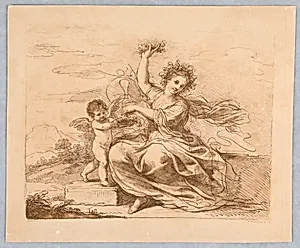
Flora, with a Cupid
Classification
Department
Smithsonian Collection
Museum
Smithsonian American Art Museum
Credit
Bequest of George Campbell Cooper
Accession Number
1896-3-287
Rights
Public Domain
About this artwork
Research in Progress
Art Historical Context
**Flora, with a Cupid** *Francesco Bartolozzi (Italian, active England, 7–1815), ca. 1760–1770 Print; Smithsonian American Art Museum, Bequest of George Campbell* Step into the enchanting world of 18th-century printmaking Francesco Bartolozzi's *Flora, with a Cupid*. This delicate print captures the Roman goddess of flowers, Flora, accompanied by the mischievous Cupid, embodying the playful elegance of Rococo and neoclassical tastes. Bartolozzi, a Florentine-born engraver who thrived in England during this period, was a master of stipple technique—a dotted method that created soft, luminous effects ideal for reproducing painterly originals. Though the specific medium details are under research, his prints were celebrated for making high art accessible to a wider audience beyond elite collectors. Created around 1760–1770, amid London's vibrant artistic scene, the work reflects Bartolozzi's role in bridging Italian virtuosity with British patronage. He often collaborated on reproductive engravings after leading painters, infusing mythological subjects like this floral duo with graceful linework and subtle shading. Housed in the Smithsonian American Art Museum through the generous bequest of George Campbell Cooper, it highlights prints' cultural role in disseminating beauty and classical lore during the Enlightenment era. Fun fact: Bartolozzi's innovations in stippling influenced generations, paving the way for color printing techniques that brought antique myths into modern homes. A timeless gem awaiting further discovery! (198 words)