
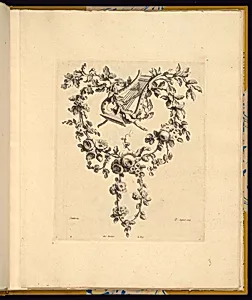
Floral Tailpiece
Medium
Classification
Department
Smithsonian Collection
Museum
Smithsonian American Art Museum
Credit
Purchased for the Museum by the Advisory Council
Accession Number
1921-6-234-3
Rights
Public Domain
About this artwork
Research in Progress
Art Historical Context
Jean-Jacques Bachelier, prominent French artist (1724–1806), created *Floral Tailpiece* 1760, a print that exemplifies the ornate floral motifs of the Rococo era. Working during the lavish mid-18th century in France, Bachelier in botanical designs, contributing to the renowned Sèvres porcelain manuf and producing intricate illustrations that adorned luxury goods and publications. As a "tailpiece"—a decorative engraving typically placed at the end of a book chapter or page—this print served both aesthetic and functional purposes, signaling closure with its blooming elegance. The medium of print allowed Bachelier's precise line work and naturalistic flowers to be widely reproduced, bridging fine art with decorative arts. Rococo's playful asymmetry and exuberant naturalism shine here, reflecting the period's fascination with nature as escapism from rigid court life. Acquired by the Smithsonian American Art Museum through its Advisory Council, this piece highlights transatlantic exchanges in ornamental design. Though research continues, *Floral Tailpiece* invites visitors to appreciate how such ephemera captured the era's joie de vivre, blending artistry with everyday elegance. (178 words)