
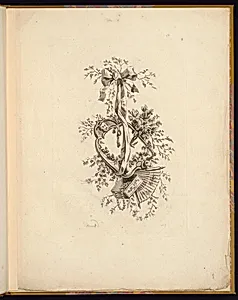
Design for a Pendant Trophy
Classification
Department
Smithsonian Collection
Museum
Smithsonian American Art Museum
Credit
Purchased for the Museum by the Advisory Council
Accession Number
1921-6-382-8
Rights
Public Domain
About this artwork
Research in Progress
Art Historical Context
Jean-Baptiste Pillement, a French artist (1728–1808), was a master of the Rococo, renowned for his intricate ornamental designs, flowing landscapes, and decorative motifs inspired by nature. Active across Europe—from England and Portugal to Poland—Pillement bridged the exuberant curves of Rococo with emerging Neoclassical restraint. Created between 1772 and 1777, *Design for a Pendant Trophy exemplifies his talent for jewelry and trophy designs, likely intended as a blueprint for luxurious pendants worn as symbols of prestige or victory. As a print from the Smithsonian American Art Museum's collection, this work highlights Pillement's skill in translating elaborate concepts onto paper, a medium essential for disseminating designs to craftsmen and patrons. Prints like this allowed for precise replication, fueling the 18th-century decorative arts boom amid aristocratic demand for personalized finery. Though the exact printing technique remains under research, Pillement's whimsical yet elegant style—often featuring shells, foliage, and ribbons—captures the era's love for playful opulence. Acquired through the museum's Advisory Council, this piece invites us to appreciate how Pillement's designs adorned Europe's elite, blending artistry with everyday luxury. A testament to 18th-century cross-cultural exchange, it reminds visitors of art's role in elevating the personal.