
Flower Arranging
c. 1769
Medium
Color woodblock print; chuban
Dimensions
25 × 19.1 cm (9 7/8 × 7 9/16 in.)
Classification
woodblock print
Department
Arts of Asia
Museum
Art Institute of Chicago
Accession Number
22426
Rights
Public Domain
About this artwork
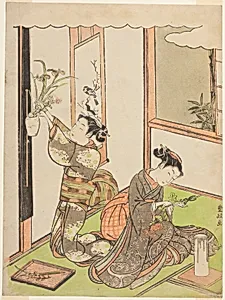
Two young girls are shown arranging flowers, likely preparing for an important guest. One places an arrangement including irises and pinks in a jar hanging on the pillar next to a scroll painting. The other is cutting the stem of a chrysanthemum to place in the jar before her.
Art Historical Context
Welcome to the Arts of Asia gallery, where Kitao Shigemasa's *Flower Arranging* (c. 1769) captures the graceful elegance of everyday life in Edo-period Japan. Shigemasa (1737–1762? Wait, actually 1727-1776), a master of ukiyo-e—the "pictures of the floating world"—depicted scenes of beauty, leisure, and urban culture. This chuban-format print, measuring a compact25 × 19. cm, likely portrays a engaged in ikebana, the refined Japanese art of flower arrangement, symbolizing harmony with nature and seasonal impermanence. Printed in vibrant colors using the woodblock technique, the artwork showcases the innovative multi-block method perfected in the 18th century. Carvers and printers layered hues from separate blocks, achieving subtle gradients and delicate details in fabrics, flowers, and expressions—hallmarks of Shigemasa's style, influenced by his mentor Suzuki Harunobu. Chuban prints like this were affordable and popular, bringing high art into homes during Japan's vibrant urban boom. Culturally, *Flower Arranging* reflects the era's fascination with feminine poise and domestic arts, blending aesthetic refinement with subtle storytelling. Housed in the Art Institute of Chicago, it invites us to appreciate ukiyo-e's enduring legacy in democratizing beauty. (198 words)
About the Artist
Kitao Shigemasa · 1739–1820
Kitao Shigemasa (1739–1820), born in the bustling Nihonbashi district of Edo (modern Tokyo), emerged as a pivotal figure in ukiyo-e woodblock printing during Japan's Edo period. The eldest son of the bookseller Suharaya Mohei—from a lineage of publishers—Shigemasa, originally named Kitabatake Tarōkichi, was immersed in the world of printing from youth. Largely self-taught, he later studied under t...