
Flower Holder
c. 1790
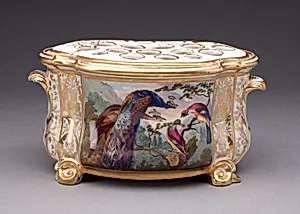
Medium
Soft-paste porcelain, polychrome enamels and gilding
Dimensions
11.7 × 21.6 × 12.7 cm (4 5/8 × 8 1/2 × 5 in.)
Classification
porcelain
Department
Applied Arts of Europe
Museum
Art Institute of Chicago
Accession Number
90939
Rights
Public Domain
Art Historical Context
Step into the refined world of late 18th-century English porcelain with this exquisite *Flower Holder* from the Porcelain Manufactory, crafted around 1790. Standing at 11.7 × 21.6 × 12.7 cm, this delicate piece exemplifies the manufactory's reputation for producing luxurious tableware and decorative objects during Britain's porcelain boom. Derby, one of England's premier factories since the 1750s, was renowned for its soft-paste porcelain—a European innovation that mimicked the translucent quality of coveted Chinese hard-paste porcelain but fired at lower temperatures, allowing for intricate shapes and vibrant finishes. The artwork shines through its masterful use of polychrome enamels and gilding. Overglaze enamels, applied in rich hues and fired separately, created durable, jewel-like colors, while gilding added a touch of opulent sparkle, highlighting edges and motifs. This technique not only demonstrated technical virtuosity but also catered to the tastes of the aristocracy, who adorned their homes with such functional artistic wares amid the neoclassical revival. Housed in the Art of Chicago's Department of Applied Arts of Europe, this flower holder bridges utility and beauty, reflecting porcelain's cultural ascent as a status symbol. It invites us to appreciate how Derby's innovations elevated everyday objects into enduring treasures.
About the Artist
Derby Porcelain Manufactory · 1751–1785
The Derby Porcelain Manufactory stands as one of the foundational institutions of British ceramic art, producing some of the finest figures and tablewares made in England during the eighteenth and early nineteenth centuries. Its origins can be traced to the work of André Planché, a Huguenot immigrant from Saxony who settled in Derby around 1745 and began producing soft-paste porcelain figures and ...