
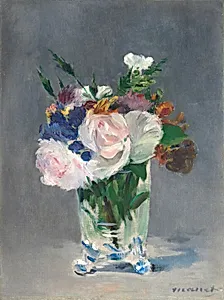
Flowers in a Crystal Vase
c. 1882
Medium
oil on canvas
Dimensions
overall: 32.7 x 24.5 cm (12 7/8 x 9 5/8 in.) framed: 52.7 x 44.8 x 8.3 cm (20 3/4 x 17 5/8 x 3 1/4 in.)
Classification
Painting
Department
CF
Museum
National Gallery of Art, Washington, D.C.
Credit
Ailsa Mellon Bruce Collection
Accession Number
1970.17.37
Rights
Public Domain
Art Historical Context
Edouard Manet's *Flowers in a Crystal Vase* (c. 1882) is a delicate oil-on-canvas still life, measuring just 32.7 x 24.5 cm, inviting intimate contemplation. Painted late in the artist's career, it captures a bouquet arranged in a shimmering crystal vase, rendered with Manet's signature loose brushwork and vibrant color contrasts. This small-scale work, now in the National Gallery of Art's Ailsa Mellon Bruce Collection, exemplifies the French master's ability to elevate everyday subjects into modern poetry. Manet, a pivotal figure bridging Realism and Impressionism, turned increasingly to floral still lifes in his final years, partly due to declining health from syphilis that limited his mobility. Created around 1882, this piece reflects the era's fascination with domestic interiors and the fleeting beauty of nature amid Paris's urban bustle. Unlike rigid academic compositions, Manet's approach emphasized direct observation, bold lighting, and textured strokes, influencing younger Impressionists like Monet and Renoir. Its cultural significance lies in redefining still life as a vehicle for personal expression rather than mere decoration. The crystal vase's translucency and the flowers' lively blooms showcase oil's luminosity on canvas, making this gem a quiet testament to Manet's enduring innovation. Visitors will appreciate its subtle elegance, perfect for quiet gallery reflection.
About the Artist
Edouard Manet · 1832–1883
Édouard Manet (1832-1883) was a French painter who played a pivotal role in the transition from Realism to Impressionism, often called the 'Father of Modern Art.' Born into a wealthy Parisian family, Manet defied his father's wishes for a legal career to pursue painting, studying under academic artist Thomas Couture. His revolutionary works 'Le Déjeuner sur l'herbe' and 'Olympia' (both 1863) scand...