
Folding armchair (sedia a Savonarola type)
Unknown Artist
15th century (textile); 19th century (chair, with various earlier parts)
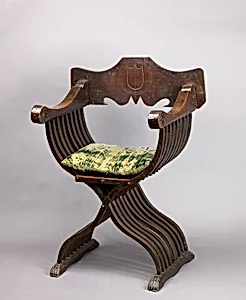
Medium
Walnut, partly turned and carved; green velvet.
Dimensions
H. 98.2 cm, W. 64 cm, D. 55.2 cm; Cushion: 35 x 46 cm.; Fragment 55.5 x 21 cm.
Classification
Textiles-Velvets|Woodwork-Furniture
Culture
Italian
Department
Robert Lehman Collection
Museum
Metropolitan Museum of Art, New York, NY
Credit
Robert Lehman Collection, 1975
Accession Number
1975.1.1983 a,b,c
Rights
Public Domain
Art Historical Context
This elegant folding armchair, known as a *sedia a Savonarola*, exemplifies Italian Renaissance furniture design with its lightweight, portable X-frame structure. Crafted primarily from walnut—partly turned and intricately carved—the chair stands 98.2 cm high, with a seat cushion of lush 15th-century green velvet (35 x 46 cm) and a textile fragment (55.5 x 21 cm). While the chair frame dates to the 19th century, it incorporates various earlier components, creating a fascinating composite of Italian craftsmanship across centuries. The Savonarola type, popular from the 15th century onward, was prized for its foldability, making it ideal for travelers, clergy, and nobility. The turned walnut legs and carved details highlight skilled woodwork techniques, while the opulent velvet upholstery speaks to the era's luxury textiles, often produced in Italian weaving centers like Venice or Florence. Such chairs symbolized status and mobility in a time when portable furnishings bridged domestic and nomadic life. Housed in the Metropolitan Museum of Art's Robert Lehman Collection (acquired 1975), this piece offers a tangible link to Italy's furniture heritage, blending utility with artistry in the Department of Textiles-Velvets and Woodwork-Furniture. Visitors can appreciate how it reflects evolving tastes, from Renaissance opulence to 19th-century revival.