
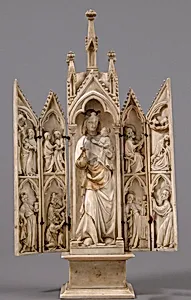
Folding Shrine with Virgin and Child
Unknown Artist
ca. 1340–50
Medium
Elephant ivory with metal mounts
Dimensions
Overall (open): 11 x 6 3/16 x 2 1/16 in. (27.9 x 15.7 x 5.3 cm) Overall (Closed): 11 x 2 11/16 x 2 in. (27.9 x 6.9 x 5.1 cm) Central element without base and finials: 6 15/16 x 2 1/8 x 1 1/2 in. (17.7 x 5.4 x 3.8 cm) Inner wings L & R: 6 7/16 x 1 1/16 x 1/4 in. (16.3 x 2.7 x 0.6 cm) Outer wings L & R: 6 9/16 x 1 x 1/4 in. (16.7 x 2.6 x 0.6 cm) Base: 1 5/8 x 2 1/16 x 2 3/4 in. (4.1 x 5.3 x 7 cm)
Classification
Ivories-Elephant
Culture
French
Department
Medieval Art
Museum
Metropolitan Museum of Art, New York, NY
Credit
Theodore M. Davis Collection, Bequest of Theodore M. Davis, 1915
Accession Number
30.95.115
Rights
Public Domain
Tags
Art Historical Context
This exquisite *Folding Shrine with Virgin and Child*, crafted France around 1340–50, exemplifies the refined artistry of medieval ivory carving. Made from elephant ivory with metal mounts, this portable object opens to reveal a central figure of the Virgin Mary holding the Christ Child, flanked by hinged wings that likely depict attendant saints or angels. When closed, it compacts neatly for travel, measuring just 11 x 2 11/16 inches, transforming into a protective tabernacle-like container—a clever design suited for pilgrims or private prayer. Ivory was a luxurious medium in the Gothic era, prized for its smooth, luminous quality that allowed carvers to achieve intricate details and a lifelike softness in the figures' drapery and expressions. The metal mounts added durability and perhaps gilded accents, enhancing its sacred aura. Such shrines were personal treasures for the devout, bridging the divine and everyday life during a time when devotion to the Virgin was central to Christian piety. Housed in the Metropolitan Museum of Art's Medieval Art collection (Theodore M. Davis Collection, 1915), this anonymous masterpiece invites us to ponder the faith and skill of 14th-century artisans, offering a window into a world where art and spirituality intertwined seamlessly.