
Folding stool (pliant) (one of a pair)
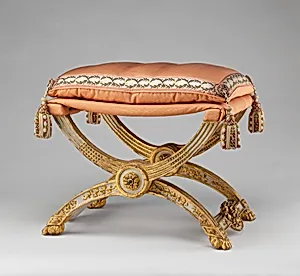
Medium
Carved and painted beechwood, covered in pink silk
Dimensions
18 1/4 in. × 27 in. × 20 1/4 in. (46.4 × 68.6 × 51.4 cm)
Classification
Woodwork-Furniture
Culture
French
Department
European Sculpture and Decorative Arts
Museum
Metropolitan Museum of Art, New York, NY
Credit
Gift of Mr. and Mrs. Charles Wrightsman, 1977
Accession Number
1977.102.10
Rights
Public Domain
Art Historical Context
Step into the opulent world of late 18th-century France with this exquisite folding stool, or *pliant*, crafted in 1786 by a masterful team of Parisian artisans: Jean-Baptiste-Claude Sené, the renowned *menuisier* (cabinetmaker), alongside Nicolas François Vallois, Louis-François Chatard, and Chaudron. Produced during the lavish final years of the Ancien Régime, just before the French Revolution, this piece—one of a pair—exemplifies the neoclassical elegance favored by Louis XVI's court. Sené, who supplied furniture to Versailles, specialized in such refined seating, blending functionality with aristocratic splendor. Fashioned from carved and painted beechwood and upholstered in vibrant pink silk, the stool measures a compact 18¼ × 27 × 20¼ inches, perfect for portable use in grand salons or gardens. The beechwood's intricate carving and faux finishes mimicked costlier materials like mahogany, while the silk upholstery added a touch of feminine luxury. This technique highlighted the era's decorative arts mastery, where woodworking met painting and textiles in harmonious trompe-l'œil effects. A generous gift to The Metropolitan Museum of Art from Mr. and Mrs. Charles Wrightsman in 1977, this stool offers a glimpse into the refined tastes of French nobility. Pliants like this were status symbols, folding neatly for versatility yet unfolding into seats of unparalleled grace—timeless reminders of pre-revolutionary extravagance.
About the Artist
Jean-Baptiste-Claude Sené|Nicolas François Vallois|Louis-François Chatard|Chaudron ( | ) · 1748 |1749 –1803 |1819
1748–1803|ca. 1749–1819