
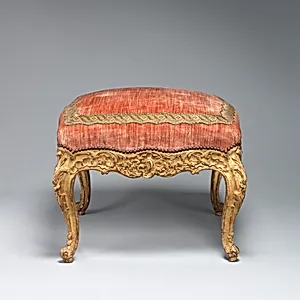
Stool (tabouret) (one of a pair)
Medium
Beechwood frame, carved and gilded, upholstered in modern velvet.
Dimensions
confirmed: 18 3/4 × 22 1/2 × 22 1/2 in. (47.6 × 57.2 × 57.2 cm)
Classification
Woodwork-Furniture
Culture
French, Paris
Department
European Sculpture and Decorative Arts
Museum
Metropolitan Museum of Art, New York, NY
Credit
Bequest of Mrs. Charles Wrightsman, 2019
Accession Number
2019.283.20
Rights
Public Domain
Art Historical Context
This exquisite pair of stools (tabourets), crafted around 1740–50 by the renowned Tilliard family—Jean I and his son Jean-Baptiste II—emplifies the opulence of mid-18th-century Frenchoco furniture. Hailing from Paris, these pieces were likely produced in the workshops of these master ébénistes (cabinetmakers), who in seating for the aristocracy. With dimensions of about 18¾ × 22½ × 22½ inches, they served as symbols of prestige, reserved for high-ranking nobility at Versailles, where only duchesses might perch on such stools in the king's presence. The stools' beechwood frames are intricately carved with the flowing, asymmetrical motifs typical of the Louis XV style—think acanthus leaves, shells, and C-scrolls—then lavishly gilded for a shimmering effect that caught the candlelight of grand salons. Originally upholstered in luxurious fabrics, they now feature modern velvet to preserve their form while evoking the era's sumptuousness. The Tilliards' mastery of carving and gilding elevated furniture to sculpture, blending functionality with artistic bravura. A generous bequest from Mrs. Charles Wrightsman brought these gems to The Metropolitan Museum of Art in 2019, where they shine in the European Sculpture and Decorative Arts galleries. They offer a glimpse into the refined world of ancien régime France, where every furnishing whispered status and elegance.