
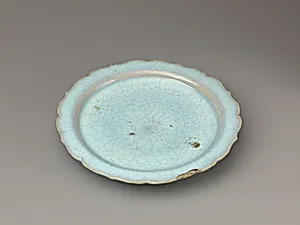
Foliate-rim plate, Jun ware
ca. 13th century
Medium
Stoneware with blue glaze.
Dimensions
Diameter: 7 1/4 in. (18.4cm.)
Classification
Ceramics
Culture
Chinese
Department
Robert Lehman Collection
Museum
Metropolitan Museum of Art, New York, NY
Credit
Robert Lehman Collection, 1975
Accession Number
1975.1.1658
Rights
Public Domain
Art Historical Context
This exquisite foliate-rim plate the mastery of Jun ware, a celebrated Chinese ceramic tradition from the Song and Yuan dynasties (roughly 10th–14th centuries). Crafted around the 13th century, this stoneware piece features a distinctive leaf-shaped rim and a thick, crackled blue glaze that evokes the ethereal hues of a twilight sky. Measuring 7¼ inches in diameter, its subtle imperfections—born from the kiln's unpredictable firing process—highlight the artisanal ingenuity of potters in Henan province, where Jun ware originated. Jun ware's artistic significance lies in its innovative glazing technique: iron-rich glazes were fired at high temperatures in wood-burning kilns, yielding mesmerizing blues, purples, and lavender tones that shifted dramatically based on oxygen levels and placement. Revered for their otherworldly beauty, these wares symbolized harmony with nature and were favored by imperial courts, though many, like this plate, were likely produced for elite collectors. Housed in the Metropolitan Museum of Art's Robert Lehman Collection since 1975, this plate invites visitors to appreciate the poetic fusion of form and flux in Chinese ceramics—a testament to a golden age of innovation where each glaze told a unique story of fire and earth.
About the Artist
Chinese
The artist known simply as "Chinese" in museum records represents the vast tradition of anonymous or unattributed masters in Chinese art history, with 99 works preserved in our collection. These pieces exemplify the enduring legacy of guó huà, or traditional Chinese painting, one of the world's oldest continuous artistic practices. Early life is not well documented, as is common for many practitio...