
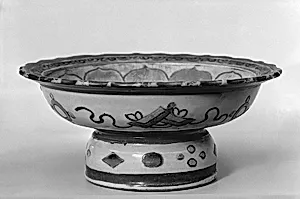
Foliated dish with lotus design
Unknown Artist
19th century
Medium
Porcelain painted in overglaze polychrome enamels (Bencharong ware for Thai market )
Dimensions
H. 2 1/4 in. (5.7 cm); Diam. 5 3/8 in. (13.7 cm)
Classification
Ceramics
Culture & Period
China · Qing dynasty (1644–1911)
Department
Asian Art
Museum
Metropolitan Museum of Art, New York, NY
Credit
Avery Fund, 1909
Accession Number
09.70.78
Rights
Public Domain
Art Historical Context
This exquisite foliated dish, adorned with a delicate lotus design, exemplifies the artistry of 19th-century Chinese porcelain tailored for the Thai market.ed during the Qing dynasty1644–1911), its scalloped, leaf-like rim (measuring 5 3/8 inches in diameter and 21/4 inches high) evokes natural forms, while the central lotus motif blooms vibrantly against a backdrop painted in overglaze polych enamels. Known as Bencharong ware—named for the Thai term meaning "five colors"—this porcelain was fired at low temperatures after glazing, allowing for the bright, intricate enamels that wouldn't survive higher kiln heats. Bencharong pieces like this were luxury exports from Jingdezhen kilns, commissioned by Thai nobility for royal courts and temples. The lotus, a symbol of purity and enlightenment in Buddhist traditions prevalent in Thailand, underscores its cultural resonance, blending Chinese technical mastery with Southeast Asian tastes. Such dishes held practical yet ceremonial roles, serving sweets or betel nut during elite gatherings. Today, housed in the Metropolitan Museum of Art's Asian Art Department (acquired via the Avery Fund in 1909), this dish highlights the global trade networks of the Qing era, where porcelain bridged empires and inspired cross-cultural splendor.