
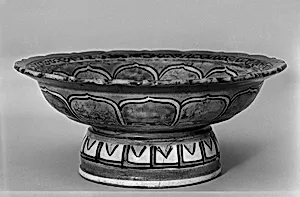
Footed Dish
Unknown Artist
late 18th–19th century
Medium
Porcelain painted in overglaze polychrome enamels
Dimensions
H. 3 1/4 in. (8.3 cm); Diam.7 3/4 in. (19.7 cm)
Classification
Ceramics
Culture & Period
China · Qing dynasty (1644–1911)
Department
Asian Art
Museum
Metropolitan Museum of Art, New York, NY
Credit
Avery Fund, 1909
Accession Number
09.70.103
Rights
Public Domain
Art Historical Context
This elegant footed dish, crafted in China during the Qing dynasty (4–1911) in the late 18th 19th century, the era's mastery of porcelain artistry. Produced likely at Jingdezhen, the world's porcelain capital, such vessels were prized for both imperial courts and export markets, reflecting China's enduring influence on global ceramics. Standing just 3¼ inches high with a 7¾-inch diameter, its raised foot adds grace, making it ideal for serving delicate foods or sweets in refined settings. The dish's medium—porcelain painted in overglaze polychrome enamels—highlights innovative Qing techniques. Fine white porcelain was first fired to vitrification, then decorated with vibrant enamels applied over the glaze and low-fired to fuse colors without dulling them. This allowed for luminous reds, blues, and golds, often in floral or figural motifs, showcasing the period's opulence amid economic shifts like the Opium Wars. Acquired through the Avery Fund in 1909 for the Metropolitan Museum of Art's Asian Art collection, this anonymous masterpiece invites us to appreciate Qing porcelain's technical brilliance and cultural prestige, bridging East and West in everyday luxury.