
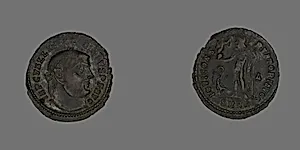
Follis (Coin) Portraying Emperor Licinius
Medium
Bronze
Dimensions
Diam.: 2.5 cm (1 in.)
Classification
coin
Department
Arts of Greece, Rome, and Byzantium
Museum
Art Institute of Chicago
Accession Number
141678
Rights
Public Domain
Art Historical Context
This bronze follis, minted in 313 CE, features a portrait of Emperor Licinius, a key figure in the late Roman. Measuring just 2.5 cm in diameter, this unassuming coin was part of everyday currency during a turbulent era. Licinius ruled as co-emperor alongside Constantine I, governing the eastern provinces after rising through the Tetrarchy system established by Diocletian. Struck in the pivotal year of the Edict Milan—which granted religious tolerance to Christians—this piece captures the imperial imagery that symbolized authority and stability amid civil strife. Roman coinage like this follis exemplified advanced minting techniques: metal was hammered between engraved dies to create detailed obverse portraits and symbolic reverses, often glorifying the emperor or deities like Jupiter or Sol Invictus. The large size and bronze composition made follises accessible to the masses, serving not just as money but as propaganda tools disseminating the ruler's likeness across the empire. Housed in the Art Institute of Chicago's Arts of Greece, Rome, and Byzantium department, this coin offers a tangible glimpse into the transition from pagan to Christian Rome, highlighting how even small artifacts wielded immense cultural power in shaping public loyalty.
About the Artist
Ancient Roman
The artists attributed to "Ancient Roman" in museum collections represent the anonymous craftsmen who produced the vast output of sculpture, frescoes, mosaics, and reliefs defining Roman visual culture from the Republic (c. 509–27 BCE) to the late Empire (c. 395 CE). Individual identities remain elusive, as Roman makers were typically viewed as skilled tradesmen—often enslaved Greeks or provincial...