
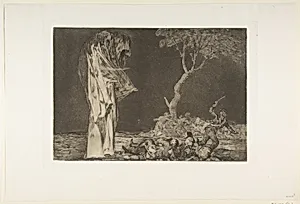
'Folly of Fear' from the 'Disparates' (Follies / Irrationalities)
ca. 1815–19 (published 1864)
Medium
Etching, burnished aquatint, drypoint
Dimensions
sheet: 12 5/8 x 18 7/8 in. (32 x 48 cm) plate: 9 5/8 x 13 13/16 in. (24.5 x 35.1 cm)
Classification
Prints
Department
Drawings and Prints
Museum
Metropolitan Museum of Art, New York, NY
Credit
Gift of Mrs. Henry J. Bernheim, 1936
Accession Number
36.20(2)
Rights
Public Domain
Tags
Art Historical Context
Francisco de Goya's "Folly of Fear," created around 1815–19, belongs to his enigmatic "Disparates" series, also known as "Follies" or "Irrationalities." This late body of work captures the Spanish artist's fascination with the irrational forces that govern human behavior. The print depicts men gripped by overwhelming terror, embodying the series' exploration of fear as a collective folly that distorts reality and reason. Goya employed etching, burnished aquatint, and drypoint to achieve dramatic contrasts of light and shadow, giving the figures an almost spectral presence. These techniques allowed him to evoke psychological depth and ambiguity, transforming the print into a haunting meditation on vulnerability. Though the series remained unpublished during his lifetime and only appeared in 1864, it reflects the disillusionment of post-Napoleonic Spain, where political upheaval and social anxieties lingered. As part of Goya's final printmaking efforts, "Folly of Fear" stands as a powerful testament to his ability to blend satire with profound empathy, inviting viewers to confront the timeless grip of irrational dread.
About the Artist
Goya (Francisco de Goya y Lucientes) · 1746–1828
Francisco José de Goya y Lucientes (1746-1828) was a Spanish painter and printmaker considered the last of the Old Masters and the first of the moderns. Rising from modest provincial origins to become First Court Painter to Charles IV, Goya's career spanned the Enlightenment's optimism and the brutal Napoleonic invasion that shattered it. A mysterious illness in 1793 left him permanently deaf and ...